Electoral processes are at the heart of democracy’s ability to resolve conflict peacefully, and much of the Kofi Annan Foundation’s work in support of elections aims to ensure they provide citizens with a real voice in how they are governed, and by whom. Without credible elections, citizens have no recourse to peaceful political change and the risk of conflict increases.
Over the years, the Kofi Annan Foundation has worked to deepen the integrity of elections; to ensure that opposition organisations are free to organise and campaign without fear. We have pushed to ensure that fraud, intimidation, and corruption are checked, and that legal mechanisms to address election-related disputes exist, providing Candidates, Parties, and voters with legal recourse to uphold their political rights.
Experience has taught us that the causes of electoral violence sometimes go beyond the conduct of elections themselves. A host of other factors – historical, economic, social, and even demographic – can influence the likelihood that a given election may experience violence.
Understanding these factors is central to identifying which elections require increased attention and support, and this can help inform our work and that of the many organisations similarly dedicated to protecting and promoting democracy and electoral integrity.
“Elections are at the heart of democracy. When conducted with integrity, they allow citizens to have a voice in how and by whom they are governed.”
Kofi Annan
Predicting Election-Related Violence
The Kofi Annan Foundation has partnered with UpSight QRA, an independent forecasting company founded by researchers at Uppsala University, to develop the Electoral Vulnerability Index (EVI) as a tool for predicting election-related violence.
The Index and its two models draw on a range of data sources to identify elections on the horizon that may be particularly vulnerable to violence and to provide international and domestic actors with a deeper understanding of where to prioritise their efforts. The first model seeks to identify overall vulnerability to violence, while the second explores the specific impact of social media and digital tools.
The Electoral Vulnerability Index is designed to help focus the attention of international and regional organisations, civil society, the media, and others on electoral processes that may be particularly vulnerable to violence.
The technical report, available for download at the bottom of this page, fully explains the data, methodology, and testing used to develop the indexes.
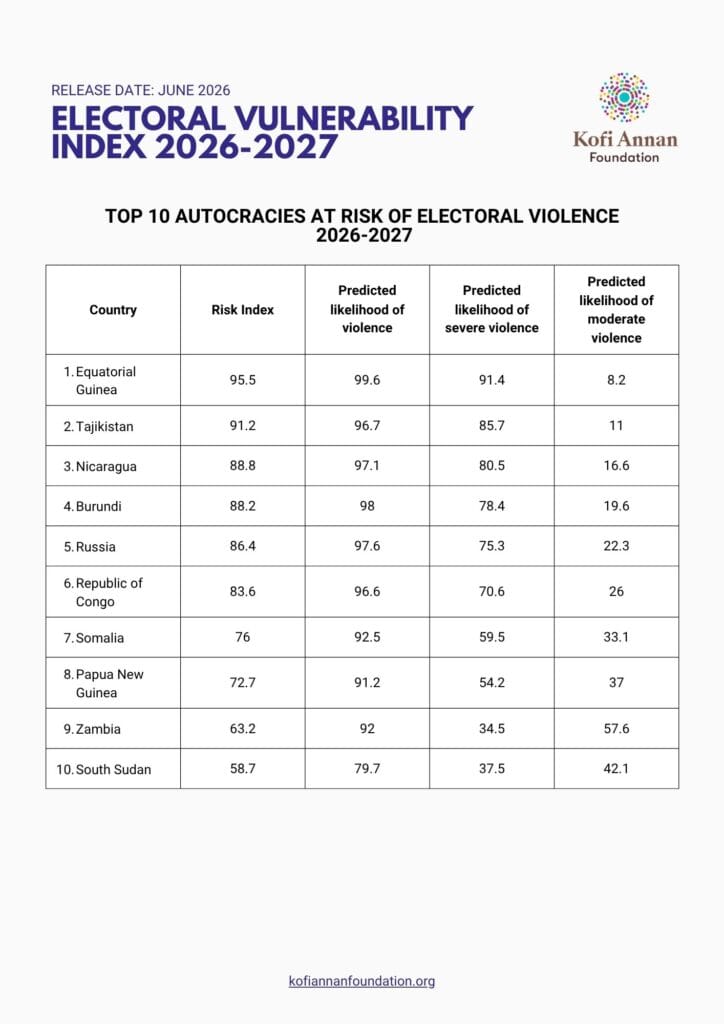
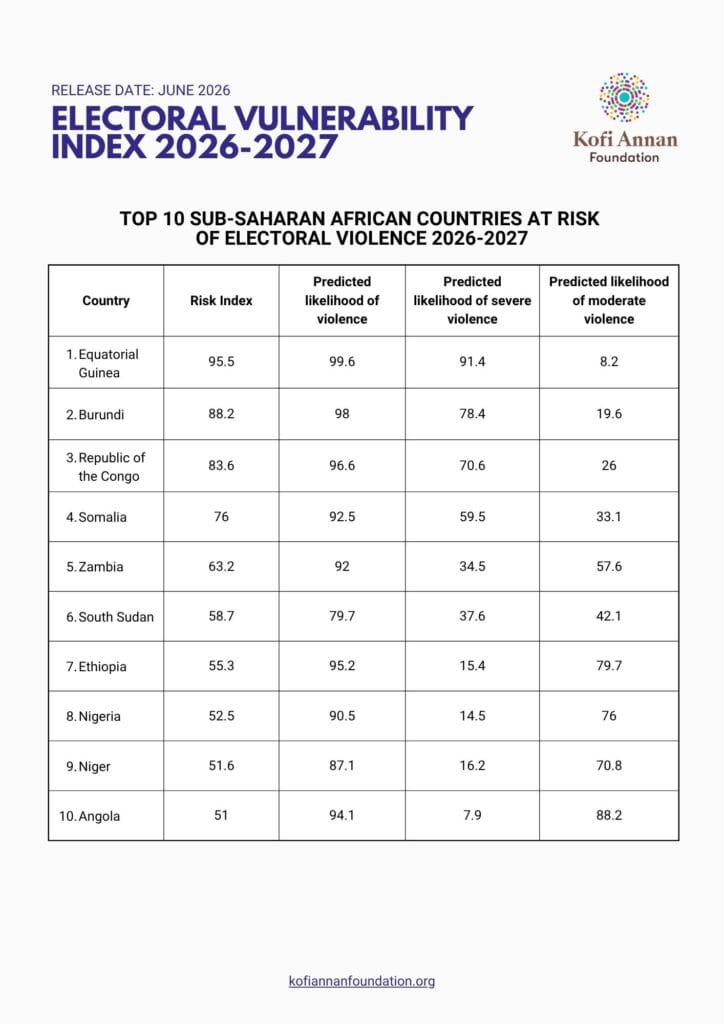
The lists below reflect the Index findings, showing the risk of violence and probability of violence in countries holding elections over the next 18 months.
The top 15 electionswith elevated risk of violence 2026-2027The top 10 democracies most at risk of electoral violence 2026-2027The top 10 autocracies most at risk of electoral violence2026-2027The top 10 Sub-Saharan African countries most at risk of electoral violence 2026-2027The top 10 EU countries most at risk of electoral violence2026-2027The top 6 Latin American countries most at risk of electoral violence 2026-2027
Index 2: Identifying Digital Vulnerabilities
Social media and digital tools are becoming ubiquitous in elections – and while they still provide unrivalled power to engage, educate and empower voters, they are also driving polarisation, facilitating the spread of disinformation, and undermining the electorate’s trust in fundamental democratic processes and electoral institutions.
In 2020, researchers working with the Kofi Annan Commission on Elections and Democracy in the Digital Age (KACEDDA) suggested that it was possible to identify certain factors that would make a country more susceptible to the weaponisation of social media– and therefore more at risk of electoral-related violence.
Drawing on this idea, we have developed a second Index that draws exclusively on data from the Digital Society Project, which includes levels of online censorship, polarisation, and politicisation of social media; misinformation campaigns; coordinated information operations; and foreign influence in, and monitoring of, domestic politics. These indicators provide a comprehensive, cross-national look at the intersection of the internet and politics, needed to assess the potential impact of digital technologies on elections.
This Index (EVI 2) allows us to identify the elections where increased attention is needed to mitigate the harmful impact of social media and digital tools; comparing it against the first table allows us to see where this impact may be significant enough to push elections into violence.
Selected Country Analyses
To complement the 2026–2027 Index, the Kofi Annan Foundation has prepared detailed analyses of ten elections in countries identified as priorities by the European Union. These analyses combine EVI risk data with qualitative assessment of the political context, electoral administration, conflict dynamics and opportunities for prevention.
Note: These rankings apply only to the ten selected country analyses published here and should not be interpreted as the ranking of all elections included in the full 2026–2027 Electoral Vulnerability Index.
The EVI is an early-warning tool designed to identify potential vulnerabilities and support preventive action; it does not predict that violence will occur.
Experience has taught us that the causes of electoral violence sometimes go beyond the conduct of elections themselves.
In brief, both Indexes draw on inputs and indicators from the V-Dem data sets and the United Nations, World Bank, Digital Society Project, Violence Early Warning System (ViEWS) and Uppsala Conflict Data Program (UCDP). These data points were organised into a series of constituent models, which were combined to provide ensemble models to provide an overall indication of the potential for electoral violence. The models were then tested against historical data to refine the final forecasts.
However, these, like all similar indices, should not be looked at in isolation, but rather considered alongside other data, qualitative information and analysis. We see this as one tool amongst many that can help to inform our engagements and those of our partners.
Previous Editions
Access previous editions of the Electoral Vulnerability Index:
In the sixth and final issue brief of our project on the intersection of multilateralism and democracy, we explore how migration governance and democratic principles are deeply intertwined. The Kofi Annan Foundation and Albert Hirschman Centre on Democracy have published the sixth issue brief from our joint project on how democratic principles and multilateral…
In the sixth and final issue brief of our project on the intersection of multilateralism and democracy, we explore how migration governance and democratic principles are deeply intertwined. The Kofi Annan Foundation and Albert Hirschman Centre on Democracy have published the sixth issue brief from our joint project on how democratic principles and multilateral cooperation intersect across major global challenges. Authored by Valerio Simoni of the Instituto de Ciências Sociais at the Universidade de Lisboa, the Albert Hirschman Centre on Democracy, and the Global Migration Centre, this issue brief focuses on migration as a key site where both democracy and multilateralism are under pressure. The…
On 2 October 2025, the Kofi Annan Foundation and the Graduate Institute’s Albert Hirschman Centre on Democracy, in partnership with the Centre for Trade and Economic Integration (CTEI), convened the fifth in a series of thematic roundtables exploring the intersections of democracy and multilateralism. The session was held as part of the…
On 2 October 2025, the Kofi Annan Foundation and the Graduate Institute’s Albert Hirschman Centre on Democracy, in partnership with the Centre for Trade and Economic Integration (CTEI), convened the fifth in a series of thematic roundtables exploring the intersections of democracy and multilateralism. The session was held as part of the Athens Democracy Forum, an annual international conference that brings together global leaders, policymakers, scholars, and activists to discuss the state of democracy. The roundtable explored the upheaval in the current global trading system, seeking to understand why the old system has failed, and how a new one, centred…
The existing trade order is unravelling at a breathtaking pace. The World Trade Organization and the rule-based trade system that promoted economic integration and globalization for much of the last 80 years is under extreme pressure from trade wars and increasing geopolitical frictions. Yet, rising protectionism and isolationism are also symptoms of…
The existing trade order is unravelling at a breathtaking pace. The World Trade Organization and the rule-based trade system that promoted economic integration and globalization for much of the last 80 years is under extreme pressure from trade wars and increasing geopolitical frictions. Yet, rising protectionism and isolationism are also symptoms of a broader public backlash against globalization and international trade. Built on the promise to deliver prosperity for all, many of the existing trade and investment rules have also intensified inequalities and exposed countries to global shocks. Especially, the distributional effects of global trade have left many groups in…
In episode 9, podcast host Ahmad Fawzi welcomes special guest Mohamed Ibn Chambas. Together, they explore trends, challenges, and opportunities for democracy in Africa. What are noteworthy examples of democratic governance on the continent? How can we restore trust in democracy, as the system best able to ensure that the voices of…
In episode 9, podcast host Ahmad Fawzi welcomes special guest Mohamed Ibn Chambas. Together, they explore trends, challenges, and opportunities for democracy in Africa. What are noteworthy examples of democratic governance on the continent? How can we restore trust in democracy, as the system best able to ensure that the voices of the people are […]
In episode 5 of Kofi Time, host Ahmad Fawzi interviews diplomat Michael Møller on Kofi Annan’s special kind of leadership. A respected leader among his peers and the public, Kofi Annan served the people of the world with courage, vision and empathy. Embodying moral steadfastness and an acute political acumen, his leadership…
In episode 5 of Kofi Time, host Ahmad Fawzi interviews diplomat Michael Møller on Kofi Annan’s special kind of leadership. A respected leader among his peers and the public, Kofi Annan served the people of the world with courage, vision and empathy. Embodying moral steadfastness and an acute political acumen, his leadership was one of […]
The following is a transcript of the speech given by Corinne Momal-Vanian at the 16TH EISA ANNUAL SYMPOSIUM in Nairobi, 11 December 2024. Navigating political transitions in Africa It is an honour to be asked to deliver this opening speech on behalf of the Kofi Annan Foundation. For most of my career,…
The following is a transcript of the speech given by Corinne Momal-Vanian at the 16TH EISA ANNUAL SYMPOSIUM in Nairobi, 11 December 2024. Navigating political transitions in Africa It is an honour to be asked to deliver this opening speech on behalf of the Kofi Annan Foundation. For most of my career, the term “transition” has meant a transition from authoritarian rule to democracy. That is why it came as a bit of a shock to realize, when I read the conference’s excellent concept note, that is now means the exact opposite. Something has gone wrong, ladies and gentlemen, and…
An open letter by the international Leadership Excellence in Politics (LEiP) Initiative We, the undersigned, unite with a shared commitment to restore trust in political leadership and enhance its practice to meet the unique demands of the 21st-century. In an era where trust in political institutions is waning, now is the time…
An open letter by the international Leadership Excellence in Politics (LEiP) Initiative We, the undersigned, unite with a shared commitment to restore trust in political leadership and enhance its practice to meet the unique demands of the 21st-century. In an era where trust in political institutions is waning, now is the time for leaders across all sectors to come together and bridge the gap between public expectations and the actions of political leaders. At this pivotal moment, we—18 representatives from academia, politics, civil society, and leadership development—invite our colleagues, peers, and funders to join us in this mission. Expectations or…
Mary Robinson, Chair of The Elders, delivered the Kofi Annan Peace Address during Geneva Peace Week 2024. Reflecting on Kofi Annan’s legacy and the current global leadership crisis in peace efforts, she called for greater respect for humanitarian law, and advocated for gender parity in leadership, emphasising the need for women’s inclusion in peacebuilding. Full Remarks…
Mary Robinson, Chair of The Elders, delivered the Kofi Annan Peace Address during Geneva Peace Week 2024. Reflecting on Kofi Annan’s legacy and the current global leadership crisis in peace efforts, she called for greater respect for humanitarian law, and advocated for gender parity in leadership, emphasising the need for women’s inclusion in peacebuilding. Full Remarks from Mary Robinson Kofi Annan Geneva Peace Address, 15 October 2024. These remarks were first published by The Elders. Excellencies, Ladies and Gentlemen It is an honour and a pleasure to be with you here tonight in my capacity as Chair of The Elders to deliver the Kofi…
In the sixth and final issue brief of our project on the intersection of multilateralism and democracy, we explore how migration governance and democratic principles are deeply intertwined. The Kofi Annan Foundation and Albert Hirschman Centre on Democracy have published the sixth issue brief from our joint project on how democratic principles and multilateral…
In the sixth and final issue brief of our project on the intersection of multilateralism and democracy, we explore how migration governance and democratic principles are deeply intertwined. The Kofi Annan Foundation and Albert Hirschman Centre on Democracy have published the sixth issue brief from our joint project on how democratic principles and multilateral cooperation intersect across major global challenges. Authored by Valerio Simoni of the Instituto de Ciências Sociais at the Universidade de Lisboa, the Albert Hirschman Centre on Democracy, and the Global Migration Centre, this issue brief focuses on migration as a key site where both democracy and multilateralism are under pressure. The…
On 2 October 2025, the Kofi Annan Foundation and the Graduate Institute’s Albert Hirschman Centre on Democracy, in partnership with the Centre for Trade and Economic Integration (CTEI), convened the fifth in a series of thematic roundtables exploring the intersections of democracy and multilateralism. The session was held as part of the…
On 2 October 2025, the Kofi Annan Foundation and the Graduate Institute’s Albert Hirschman Centre on Democracy, in partnership with the Centre for Trade and Economic Integration (CTEI), convened the fifth in a series of thematic roundtables exploring the intersections of democracy and multilateralism. The session was held as part of the Athens Democracy Forum, an annual international conference that brings together global leaders, policymakers, scholars, and activists to discuss the state of democracy. The roundtable explored the upheaval in the current global trading system, seeking to understand why the old system has failed, and how a new one, centred…
The existing trade order is unravelling at a breathtaking pace. The World Trade Organization and the rule-based trade system that promoted economic integration and globalization for much of the last 80 years is under extreme pressure from trade wars and increasing geopolitical frictions. Yet, rising protectionism and isolationism are also symptoms of…
The existing trade order is unravelling at a breathtaking pace. The World Trade Organization and the rule-based trade system that promoted economic integration and globalization for much of the last 80 years is under extreme pressure from trade wars and increasing geopolitical frictions. Yet, rising protectionism and isolationism are also symptoms of a broader public backlash against globalization and international trade. Built on the promise to deliver prosperity for all, many of the existing trade and investment rules have also intensified inequalities and exposed countries to global shocks. Especially, the distributional effects of global trade have left many groups in…
The Democratic Republic of the Congo (DRC) is expected to hold elections in December this year – a vote many see as pivotal for the country’s future. It follows a series of troubled elections which raised questions about the integrity of electoral processes and highlighted the need for various reforms. “The Catholic…
The Democratic Republic of the Congo (DRC) is expected to hold elections in December this year – a vote many see as pivotal for the country’s future. It follows a series of troubled elections which raised questions about the integrity of electoral processes and highlighted the need for various reforms. “The Catholic and Protestant churches conducted a major study of the state of election preparations in May, which revealed serious problems, some technical, and some deliberate, which call into question the integrity of the process. The people of the DRC will not brook another fraudulent election.” – Jean Bosco Lalo,…
Dakar, 8 September 2022 – The United Nations Office for West Africa and the Sahel (UNOWAS), the United Nations Development Programme (UNDP), the Open Society Initiative – West Africa (OSIWA), the Kofi Annan Foundation (KAF), and the National Democratic Institute (NDI) organized, on 6 and 7 September 2022, a colloquium on the…
Dakar, 8 September 2022 – The United Nations Office for West Africa and the Sahel (UNOWAS), the United Nations Development Programme (UNDP), the Open Society Initiative – West Africa (OSIWA), the Kofi Annan Foundation (KAF), and the National Democratic Institute (NDI) organized, on 6 and 7 September 2022, a colloquium on the enhancement of democracy and good governance in West Africa. The colloquium brought together around sixty participants, including experts and practitioners in governance and peacebuilding, and representatives of think tanks and research organizations. The colloquium was enhanced by the presence of Mr Kabiné Komara, former Prime Minister of the…
Sadly, principled statesmen and women who can forge bold, morally consistent responses to today’s global problems are in short supply. We must therefore safeguard and promote the virtues that the former UN secretary-general embodied. This article originally appeared in Project Syndicate on May 13, 2022. GENEVA – The world is facing a…
Sadly, principled statesmen and women who can forge bold, morally consistent responses to today’s global problems are in short supply. We must therefore safeguard and promote the virtues that the former UN secretary-general embodied. This article originally appeared in Project Syndicate on May 13, 2022. GENEVA – The world is facing a set of acute crises without recent parallel: a war in Europe that could escalate into a nuclear conflict, skyrocketing food prices that are hitting the poor the hardest, the COVID-19 pandemic, and the climate emergency. We need principled statesmen and women to forge bold, morally consistent responses to…
A global network that convenes election stakeholders around a shared vision: to inspire and inform action to advance electoral integrity in the face of critical threats to democracy. During a time when democratic elections around the world face an evolving and increasingly complex set of threats and challenges, sustained cooperation among global…
A global network that convenes election stakeholders around a shared vision: to inspire and inform action to advance electoral integrity in the face of critical threats to democracy. During a time when democratic elections around the world face an evolving and increasingly complex set of threats and challenges, sustained cooperation among global electoral integrity stakeholders is urgently needed. The Global Network for Securing Electoral Integrity (GNSEI or Network) convenes election stakeholders around a shared vision: to inspire and inform action to advance electoral integrity in the face of critical threats to democracy. Specifically, GNSEI brings together leading international electoral integrity…
We are delighted to join the European Partnership for Democracy (EPD) and excited to work with its members to reinforce the impact of European actions to promote and defend democracy worldwide. These are trying times for supporters of democracy. Still, the Foundation and the EPD share the conviction that democracy is the…
We are delighted to join the European Partnership for Democracy (EPD) and excited to work with its members to reinforce the impact of European actions to promote and defend democracy worldwide. These are trying times for supporters of democracy. Still, the Foundation and the EPD share the conviction that democracy is the system best suited to deliver human rights, human security, and development, and while it can appear chaotic, at its heart, democracy is far more resilient and more capable of delivering positive change, than any alternative. “The Foundation and the European Partnership for Democracy share the conviction that democracy…
The Kofi Annan Foundation is delighted to announce the launch of a new project entitled Securing the Digital Environment for the 2022 Election in Kenya, funded by the United Nations Democracy Fund. Building on the findings of the Kofi Annan Commission on Elections and Democracy in the Digital Age, the project will…
The Kofi Annan Foundation is delighted to announce the launch of a new project entitled Securing the Digital Environment for the 2022 Election in Kenya, funded by the United Nations Democracy Fund. Building on the findings of the Kofi Annan Commission on Elections and Democracy in the Digital Age, the project will address the potential impact of the internet, social media and digital technologies, both positive and negative, on electoral integrity and confidence in the electoral process in Kenya for the 2022 elections. The project will convene and facilitate a dialogue with key stakeholders to work for conditions of trust.…