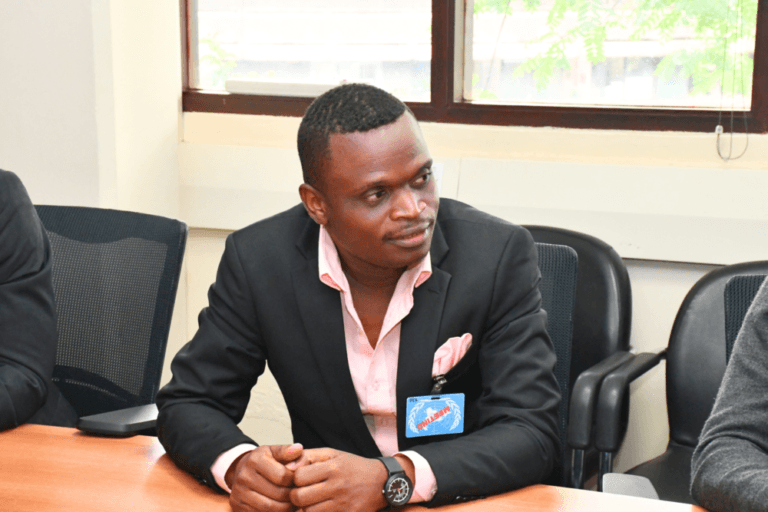
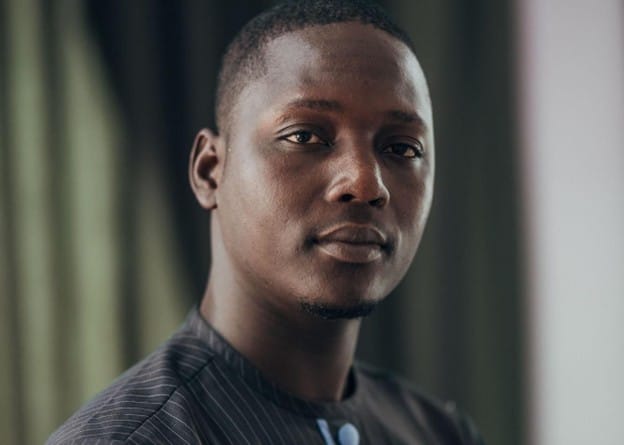
In Chad, especially in the capital, N’Djamena, many young people grow up believing that politics is not for them. They are told repeatedly that they are too young, not experienced enough, not legitimate enough. Sylvain Langue has seen this belief at work for years, down to the most contradictory details.
“In 2024, a 37-year-old opposition figure—who is now in prison—was prevented from running for president because, following a constitutional amendment, the minimum age requirement was raised to 40. How can you expect young people to still believe that the system is designed for them?” explains Sylvain.
In this deadlocked context, Sylvain decided to chart a new course, with the ambition of bringing young people, both girls and boys, back to the centre of active citizenship, where democratic transformations really take place.
From suburban neighbourhoods to citizenship programmes
Sylvain did not become a citizen through theory, but through practice. Since 2017, he has been in charge of the grassroots community organisation (OCB) at the Maison de Quartier de Dembé. His role is to identify and supervise community leaders who accompany sixty teenagers each year through a citizenship programme. Each programme supports 60 young people aged 13 to 17 over a period of five months, during which they address essential topics including:
- identity, team spirit, children’s rights
- violence, gender, positive masculinity
- adolescence, sexuality, nonviolent communication
- health, addiction, road safety
- media, environment, and community involvement.
The workshops are accompanied by outdoor activities, cultural visits, civic initiatives, clean-up campaigns, and door-to-door hygiene or education visits.
Sylvain knows the system from the inside
“I started out as a participant. Then I was asked to replicate the training programmes in other districts. That’s what showed me how eager young people are to get involved, everywhere in N’Djamena.”
His involvement then extended to the ODD Living Lab, a citizen laboratory where young people access resources, design projects, and carry out actions aligned with the Sustainable Development Goals. There, he replicates training courses based on the modules of the Parcours programme, which focuses on 4C (Culture – Connection – Skills – Community), in several districts of the capital between 2021 and 2024. A very diverse audience of students, out-of-school youth, and Koranic school students is impacted by these actions.
“When you give them the right information, young people get involved immediately.”
The political turning point
The real shock came when he asked a group of young people about their right to hold the mayor accountable. Their reaction was unanimous:
“Do you want us to go to prison?”
This reaction struck a chord with the young Chadian leader, who is approaching 30 and believes that if young people are afraid to exercise a basic right, then a space must be created to deconstruct that fear.
This is how he came up with the idea for a programme that would finally talk about rights, participation, and civic responsibility.
“Young people want to get involved. They just lack the space and the means,” he says.
Thanks to the WYDE Accountability Hubs programme, he finally obtained the means to see his idea through to completion. This support enabled him to structure a project designed to have a massive impact on young people: Jeun’Action.
The project is designed to strengthen citizen participation in outlying neighbourhoods, particularly in the 7th arrondissement, one of the most vulnerable areas of N’Djamena, according to Sylvain.
Three complementary components structure the initiative, which he implemented across 2024:
- Training of trainers: 17 people are trained, including 10 girls and 2 facilitators sent by the municipality. The modules are facilitated by several partner organisations specialising in: democracy, electoral processes, citizen values, participatory governance, transparency and anti-corruption.
- Through the journey of “Jeun’Action“: after the initial training of 17 trainers, partner organisations, including the women’s organisation Super Banat and the Network of Ambassadors for Quality Education, replicated the training with their members. Each organisation trains around 30 young people, including 15 girls, while Super Banat mobilises up to 50 girls, thereby greatly increasing female participation. In total, between 120 and 130 young people benefited from the programme, with girls making up the majority, in line with Sylvain’s goal of inclusion.
- Civic Engagement Week: This marks the project’s collective action phase. The young people who received training organised: awareness campaigns in schools and public places, community actions (cleaning, hygiene, environment), and civic engagement activities focusing on rights, political participation, and accountability.
The aim was to leave the training rooms and engage the public, initiating civic dialogue in the outlying neighbourhoods.
Demand for this innovative initiative far exceeds capacity.
“We received 342 applications. The selection process was very difficult. Some young people expressed their frustration at not being able to participate. This shows the extent of the need,” says Sylvain.
Results that can be perceived on the ground
Jeun’Action’s impact is immediate. Trained young people get involved in the National Youth Council, others participate in municipal elections, or launch citizen initiatives in their neighbourhoods.
“Today, I meet young people from Jeun’Action who are taking action themselves. They are no longer waiting around,” says Sylvain happily.
Participants replicate the workshops, conduct awareness campaigns, and organise community activities. The ripple effect is real.
“Before Jeun’Action, I didn’t even know you could talk to the authorities. Today, I’ve already led an awareness session in my neighbourhood,” says one participant.
The launch of a new project to consolidate momentum
Following the success of Jeun’Action, the Kofi Annan Foundation renewed its support in 2025 by backing a new programme led by Sylvain: the Digital Democracy Initiative.
This project built on the momentum generated by WYDE Accountability Hubs, providing young people with concrete tools to understand and influence governance in the digital age.
Two workshops have already been held, covering:
- CivicTech tools,
- Digital democracy,
- Fact-checking and combating misinformation,
- Community mapping and the use of citizen participation platforms,
- Online petitions.
Launched in the 7th district, the initiative is designed to gradually expand to the entire city of N’Djamena.
“It’s the logical next step in what we’ve built with Accountability Hubs. Young people have shown that they want to understand and take action. It’s up to us to give them the right tools,” explains Sylvain.
A citizen movement that’s here to stay
Beyond the numbers, Sylvain takes away one thing: young people no longer want to be spectators.
They ask questions, challenge, organise, and take their place.
To sum up his commitment, Sylvain says:
“For a long time, people said that young people weren’t ready. But that’s because they were never given the means to do so. Today, they are proving the opposite.”
His work shows that a more inclusive, more demanding, and better-equipped citizenship is possible in Chad.