
For many young Kenyans, entering politics is a question of money. High campaign costs create an uneven playing field in which capable young leaders struggle to compete with the financial networks and access enjoyed by older, more established politicians. Candidates are often expected to spend heavily in their prospective constituencies, providing gifts and cash payments and sponsoring community events.
It is within this context that the Wezesha Vijana Kuongoza Initiative was born. Responding to widespread voter bribery and the growing exclusion of young leaders, the initiative, launched by Victor K. Kirui, seeks to empower youth in Bomet, Kericho, and Nakuru Counties through training, mentorship, and grassroots civic engagement, fostering a more inclusive and ethical approach to political campaigning.
“Voter bribery is often normalised in Kenya, it’s seen as ‘just part of politics.” explains Victor.

A journey shaped by personal experience
“I was inspired by my own experiences as a young person observing how money and voter bribery often silence competent youth voices,” Victor explains. “Seeing talented young leaders discouraged by financial barriers made me realise the urgent need to equip them with knowledge, ethics, and practical strategies to lead differently.”
Victor points to a study by the Westminster Foundation for Democracy (WFD) and the Netherlands Institute for Multiparty Democracy (NIMD) that reinforced what he was witnessing: high political financing costs were directly translating into poor governance and exclusion of young voices. The findings highlighted how the cost of politics in Kenya and other African countries has become one of the greatest threats to democratic participation.
Victor’s shift from frustration to action was made possible through the WYDE Accountability Hubs programme. “The mentorship component was invaluable,” Victor explains, “it helped refine my idea, shape the activities, and strengthen the policy angle that led to the Youth Policy Matrix on Campaign Financing.
“The Accountability Hubs network brought credibility. It helped us attract trainers, county officials, and civil society partners.”
Building knowledge and community across 3 counties
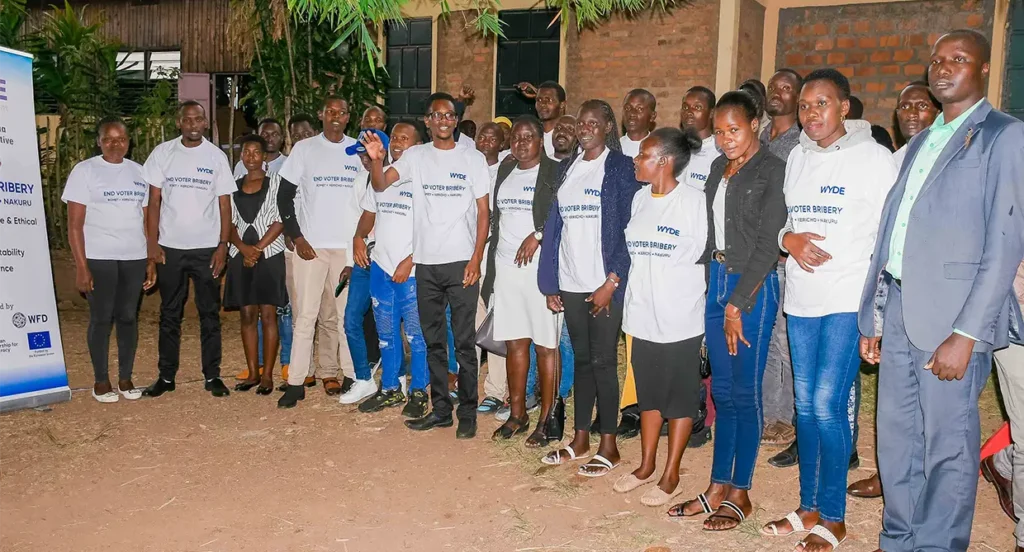
The Wezesha Vijana Kuongoza Initiative delivered a series of workshops and public engagements across Kericho, Bomet, and Nakuru counties. 60 young political aspirants took part—some previous candidates, others preparing to run in 2027. Participants were trained on:
- Ethical leadership
- Navigating the campaign financing legal framework
- Digital governance
- Civic education
- Advocacy and fundraising without bribery
- Drafting memoranda and engaging legislative processes
“We trained participants to explore legal, ethical, and low-cost fundraising models.”
These included small community contributions, in-kind support, party backing, and digital crowdfunding.
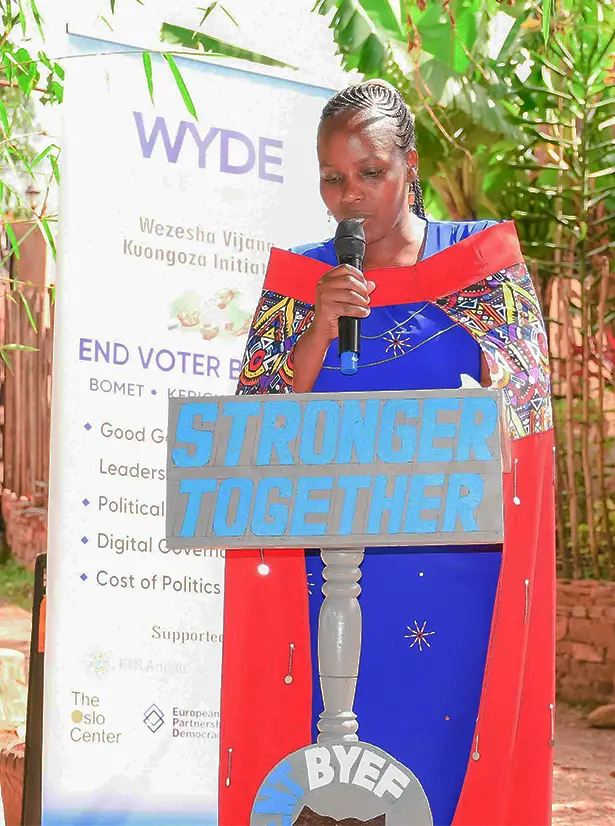
The team quickly learned that to reach the wider public, they had to meet young people where they were. This led to an unexpected evolution: a large public baraza* in Kericho County, attended by more than 500 people.
*A baraza is a term in Kenya for public forums where people freely discuss government policies or emerging issues.
Partnerships with local organisations (including Tai Mentorship and Black Coffee Network) were key to mobilising participants and building momentum. “Youth networks are the heartbeat of grassroots mobilisation,” Victor notes. These networks now continue to drive awareness through peer-to-peer outreach, WhatsApp groups, and regional coalitions. These networks are key for sustained momentum as the 2027 elections approach.
The media also played a role. “They helped bridge the gap between civic education and public interest,” Victor says. Familiar voices and influencers helped simplify complex governance concepts and make the conversation more accessible, especially to young voters.
A movement that is already changing the political landscape
The initiative significantly increased participants’ knowledge, confidence, and readiness, with 56 of 60 young participants demonstrating stronger capacity for meaningful democratic engagement. This emerging confidence was evident in their ability to co-create a Policy Matrix that proposed specific amendments to Kenya’s Campaign Financing Act. Their proposals focused on strengthening enforcement, capping campaign expenditure, and expanding public awareness on the impact of bribery.
Participants also received training in drafting memoranda and navigating formal legislative avenues. As a result, their submissions have now been formally delivered to Kenya’s Independent Electoral and Boundaries Commission, demonstrating a clear move from learning to real political engagement.
To ensure the work continues beyond the programme’s life, regional youth networks were established to build long-term alliances for advocacy and mutual support.
Perhaps most powerfully, the project began to shift thinking within communities.
“We countered the mindset [of voter bribery] by using relatable storytelling, testimonies from reformed leaders, and discussions on how bribery undermines youth chances.”
An eye on 2027
The journey was not without challenges. Kenya’s political atmosphere was tense during the implementation period. Travel costs, trainer availability, and participant financial pressures also posed obstacles. Victor overcame this by being upfront and ensuring participants were fully committed despite funding constraints. Trust, which was another key element, was built through “openness, transparency, and consistency”, says Victor. This included engaging local officials early, bringing communities into the process, and creating safe, inclusive spaces for youth voices.
Looking forward, the movement continues to grow.
“We’re scaling the mentorship programme and preparing to pilot youth-led community campaigns on ending voter bribery”
Policy advocacy remains a priority, as does preparing the next generation of ethical candidates for 2027.
Kenya’s democracy cannot belong only to those who can afford it. Through dialogue, grassroots partnership, accountability, and a commitment to integrity, young leaders like Victor are proving that ethical politics is not only possible but is already happening.