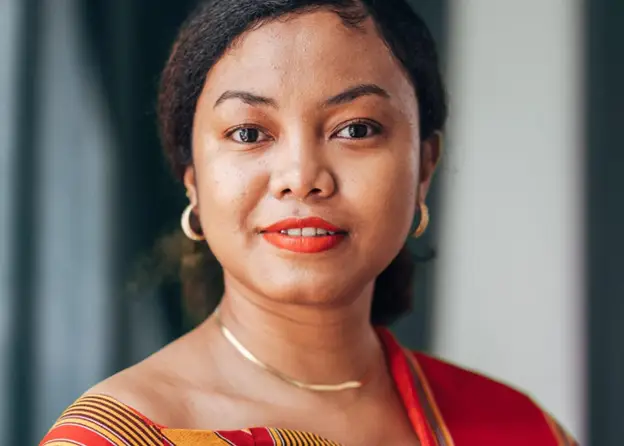
In Tsiroanomandidy—Tsiro to those familiar with its dusty streets and bustling market—young people’s civic engagement seemed to have faded over the years.
In this pivotal town in the Bongolava region, in the heart of the Red Island, public life has long been played out without its demographic majority. Young people considered politics to be the preserve of adults. There was little interest in local debates, no structured participation, and above all, no conviction that they had a role to play.
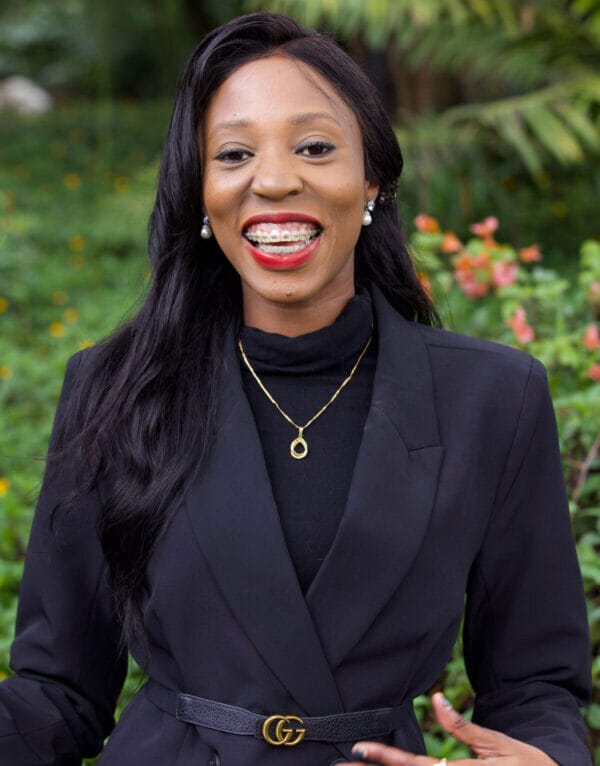
Born and raised in Tsiro, Tania Harimiora Randrianarison observed this reality closely: a lack of discussion, ignorance of civil rights, and fear of speaking in public.
“For them, politics is for adults. It wasn’t disinterest, but a legacy. A silence that was passed down, almost considered normal.”
It was in this civic inertia that Harimiora decided to shake things up.
When silence becomes a signal
Harimiora didn’t need surveys to understand that the youth of her hometown were moving forward… but without a civic compass. She observed a latent commitment, stifled by the lack of safe spaces to learn, understand, and express themselves.
Through her conversations with students, young people from the neighbourhood, and long-time acquaintances, she heard the same refrain:
“We don’t know what to do…”
“We’re not concerned…”
“It’s not for us…”
This gap between her generation’s potential and its actual place in civic life was the real wake-up call that prompted her to take action.
That’s when she came up with the idea of creating a civic and citizenship club at the high school where she studied. A space designed by and for young people, so that they could understand their rights, express themselves, and find their place in public life.
Although her project was still in its infancy, it was based on one conviction: the youth of Tsiro did not lack ability, only a space to rise up.
WYDE Accountability Hubs: the path to structured action
It is in this moment of civic emergency that the Women and Youth in Democracy (WYDE) Accountability Hubs program enters Harimiora’s story.
With the support of the European Union through the European Partnership for Democracy, the program is implemented by the Kofi Annan Foundation, the Westminster Foundation for Democracy, and the Oslo Center. It aims to strengthen democratic governance and accountability by supporting young African leaders committed to transparency and citizen participation.
When Harimiora was selected in 2023 to benefit from this strategic support, the program provided her with what she had been lacking: a framework, a method, guidance, and above all, new legitimacy to take her project beyond intuition.
“WYDE gave me a real boost”
Thanks to this impetus, her idea for a civic and citizen club has become a project ready for implementation, equipped with educational tools, a regional network, and the credibility needed to take on the field.
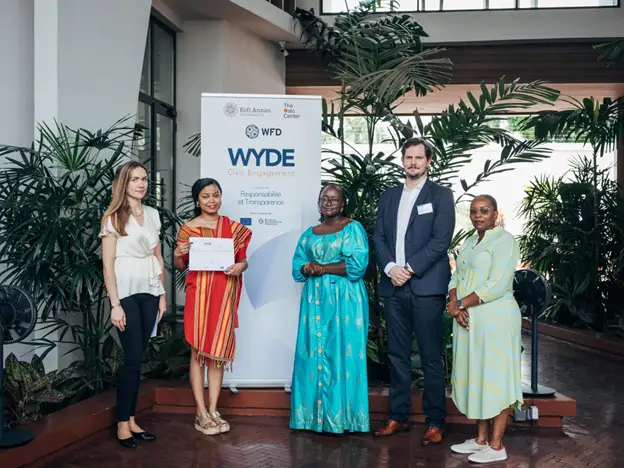
(Photo Credit: WYDE Accountability Hubs)
Building, training, and opening spaces: a project taking shape
Harimiora launched the civic and citizenship club where it all began: the high school where she studied.
But the first attempt was compromised by pressure to politicise the initiative. Faced with this shift, she refused to compromise and looked for another school. The idea survived, changed location, and found its home: La Lumière school in Tsiro.
The club was then launched with 25 young people, 80% of whom were young women and three of whom had disabilities. They elected a president and a secretary general and divided up the responsibilities.
The members receive guidance from the school’s teachers and other volunteers, but it is the young people who are in charge. The club has become a small laboratory of engagement, shaped by and for Bongolava.
Strengthening skills to regain control over public life
Harimiora then organises a series of intensive two-day training sessions, led by local consultants. The modules cover topics such as :
- Local governance,
- Citizen participation,
- The role of young people in civil and political rights,
- Gender,
- The Sustainable Development Goals.
Analysis of results from assessments conducted before and after the training sessions shows a clear improvement in the beneficiaries’ knowledge and skills.
In addition, Harimiora herself conducts training on responsible internet use, which she calls the Surf Smart module.
The agenda for this module is transforming young people’s digital practices, with them now posting more thoughtfully, managing their e-reputation better, and engaging in more responsible online debates. Young women, for their part, are speaking out more about the situation in the country, which Harimiora is keen to highlight.
She often recalls a striking statement:
“The government said that only 6% of young Madagascans had access to Facebook and that this 6% was insignificant. Yet it was thanks to this 6% that they were removed from power.”
Radio as an expanded civic space
The project extends beyond the school thanks to four radio programs broadcast in Tsiro and Antananarivo. Young club members explain civic concepts while listeners react, call in, and ask questions. Citizenship enters homes, and public debate begins.
Discovering the work of local elected officials
The final part of the initiative aims to provide an inside look at how the town hall works. The meeting with the mayor is delayed by the election, but eventually takes place. The young people discover the real duties of a local elected official, connect theory and practice, and gain concrete experience of local governance.
Navigating a politically charged landscape
Harimiora’s journey has been anything but smooth sailing. Every step forward has been met with a political obstacle. The first attempt to create the club was thwarted by attempts to politicise it. Later, a meeting with the mayor was delayed by municipal elections and the constant risk of political exploitation.
These episodes showed how sensitive the terrain could be.
“In Bongolava, every citizen initiative evolves in an environment where politics is everywhere, and neutrality must be rigorously defended.”
The young Madagascan quickly understood that setting up a civic club also meant protecting its independence. Her project adapted to this changing context, and, in the face of negotiations and pressure, the idea held firm, changed location, and eventually found its place.
Her ability to remain firm on a neutral line focused on civic education was crucial in preserving the spirit of the project.
A movement taking root
Today, the young people of Tsiroanomandidy are showing a completely different face. They have a better understanding of their rights, express themselves more easily, seek information with caution, and adopt a more responsible attitude online.
The training sessions, radio programs, and discussions they have engaged in have awakened a long-suppressed civic curiosity. Civic silence is breaking, and a generation is rising up.
For Harimiora, this is a first victory, and she is already looking ahead. She aims to expand the club to other schools, strengthen the local network, increase training opportunities, and encourage the creation of spaces where young people can discuss and learn. Her vision can be summed up in a phrase she often repeats:
“In the future, I see Madagascan youth engaged in civic, political, and citizenship issues. Youth who are actors, not spectators.”