


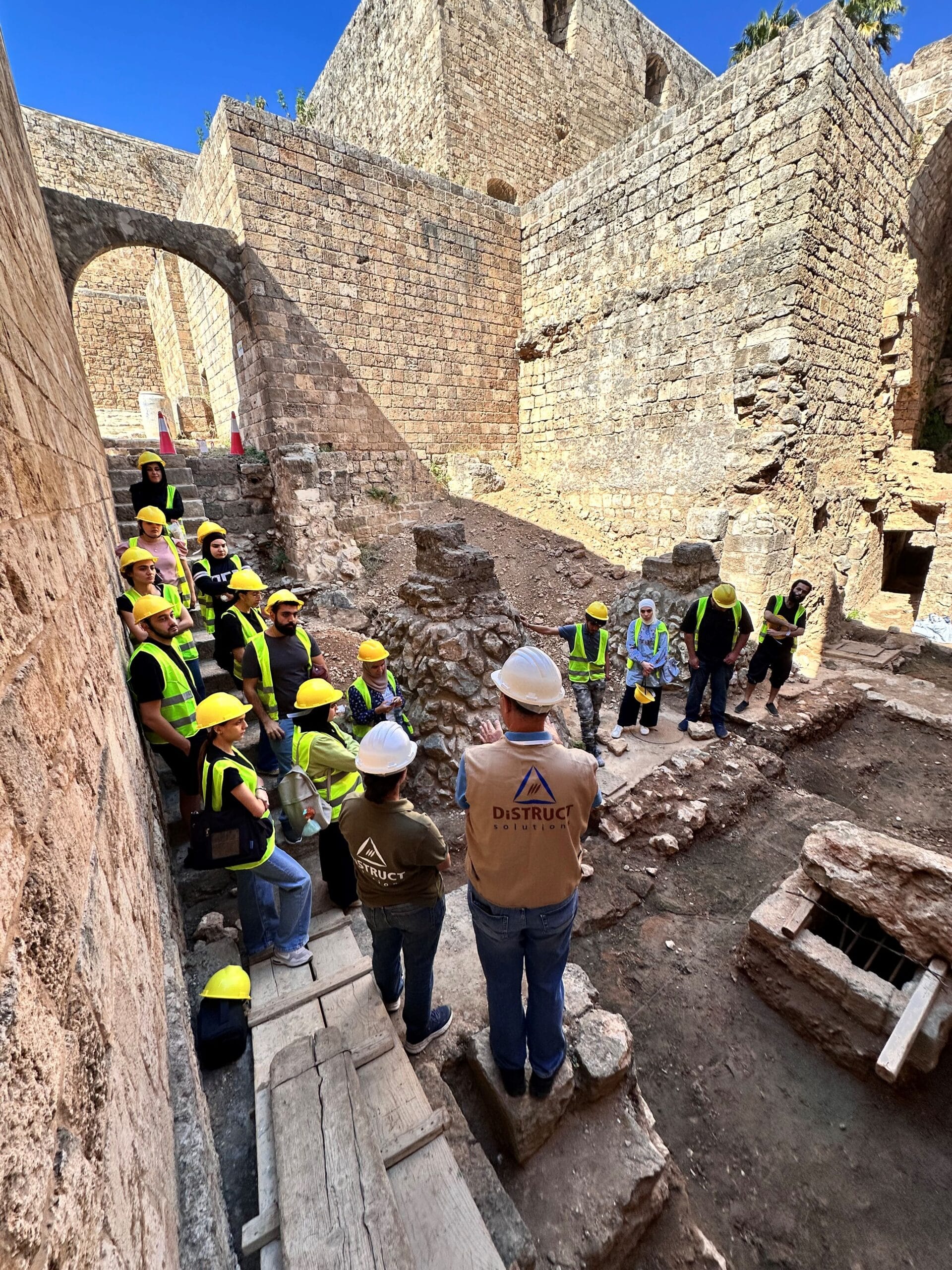
On June 2 2026, young participants in the Rooting for the Future initiative will present community projects inspired by Tripoli’s shared heritage following a 15-month-long programme focused on heritage conservation, youth empowerment, and social cohesion.
TRIPOLI, LEBANON, 28 May 2026. Young people in Tripoli are using cultural heritage to strengthen social cohesion and create new opportunities amid Lebanon’s ongoing economic and social crisis.
In 2025, the Kofi Annan Foundation, in collaboration with Fight for Humanity, Permanent Peace Movement, IECD – Semeurs d’Avenir, and the Directorate General of Antiquities, launched Rooting for the Future.
The project, made possible by support from the International alliance for the protection of heritage – ALIPH and the financial participation of the Principality of Monaco, engages Lebanese youth in restoring a major historical site while equipping them with technical and professional skills.
Over 15 months, youth from diverse backgrounds gained practical skills in heritage conservation in Tripoli while participating in dialogue and community initiatives to strengthen social cohesion and local connections.
“At a time of deep social and economic challenges, this pilot project has shown that shared cultural heritage can serve as a powerful platform for connection and cooperation,” shares Corinne Momal-Vanian, Executive Director of the Kofi Annan Foundation. “We have been delighted to work with ALIPH and our partners to support young people in Tripoli as they develop skills, rebuild confidence, and take a leading role in fostering social cohesion within their communities.”
The city’s layers of Crusader, Mamluk, and Ottoman architecture stand as living witnesses to centuries of interaction and coexistence between communities. Historical sites such as the Citadel of Tripoli can serve as inclusive spaces where generational, religious, and geographical divides can be bridged.
Participants in the Rooting for the Future project implemented critical conservation and protection measures for the Citadel of Tripoli, including the restoration of the North-East tower through vault consolidation, waterproofing, and the reformulation of rainwater drainage systems. The participants also worked outside the Citadel’s boundaries by stabilising two buildings in Tripoli’s Old City.
Alongside the conservation work, 20 youth received technical training in heritage conservation and gained life and professional skills to apply in the job market. A “worksite-school” model was implemented, enabling the participants to acquire technical expertise in material selection, masonry, structural intervention, and site management.
In parallel, a wider group of young people from diverse backgrounds around Tripoli engaged in a series of community dialogues around cultural heritage and social cohesion. This began with training youth participants in facilitation skills and the tailored/curated social cohesion curriculum. A total of 59 young people, including the youth facilitators, were led through a series of community dialogues that used the curriculum and the Citadel’s shared history as a platform for discussion and collaboration.
Participants explored themes including cultural heritage, peacebuilding, conflict and civic engagement through a series of facilitated community dialogues.
Four youth-led initiatives received seed grants to develop projects celebrating Tripoli’s tangible and intangible heritage. Activities included inclusive storytelling experiences for Deaf communities, community-led heritage tours, cultural workshops for children, and school outreach activities promoting awareness of the Citadel and the city’s shared history.
The initiative will conclude on 2 June 2026 with a vernissage at the Citadel of Tripoli, where participants will present their artistic, cultural, and community projects inspired by the city’s shared heritage.
Our aim is for the partnership to continue, and for the project to serve as a model for the region, leading to both additional crucial restoration work and alternative pathways to strengthen social cohesion in Tripoli.
In the words of Kofi Annan, “Any society that does not succeed in tapping into the energy and creativity of its youth will be left behind.”
About the Partners
The Rooting for the Future initiative is led by the Kofi Annan Foundation in collaboration with Fight for Humanity, Permanent Peace Movement, Institut Européen de Coopération et de Développement – Semeurs d’Avenir, and the Directorate General of Antiquities.
The project is made possible thanks to the support of ALIPH, with financial participation from the Principality of Monaco.
About the Kofi Annan Foundation
The Kofi Annan Foundation is an independent not-for-profit organization, established in Switzerland in 2007 by the late former UN Secretary-General Kofi Annan. Its mission is to build on Kofi Annan’s legacy for peace by advancing democracy, youth leadership and international cooperation. https://www.kofiannanfoundation.org
About Fight for Humanity
Fight for Humanity is a non-partisan, impartial, and independent NGO that works to fulfil the human rights of individuals affected by armed conflict and violence. The organization advocates for the respect for human rights in countries affected by armed violence and conflict through campaigns, dialogue and training. By reinforcing respect for human rights, Fight for Humanity also aims to contribute to peace-making and peacebuilding. https://www.fightforhumanity.org/
About Permanent Peace Movement (PPM)
PPM was founded in 1986, at the height of the Lebanese civil war, by a group of university students. Unified by their aversion to violence and common vision of a brighter, more peaceful future, they set the cornerstone for what has grown into an experienced organization that promotes peace throughout the MENA region. http://www.ppm-lebanon.org/
About Institut Européen de Coopération et de Développement (IECD)
Since its creation in 1988, the IECD, an international solidarity organisation, has been supporting human, economic and social development in the countries where it operates. Its mission is recognised as being in the public interest. Together with its local partners, it implements projects in the fields of education, entrepreneurship and access to employment through training.
https://www.iecd.org/
About the Directorate General of Antiquities (DGA)
The DGA is a Lebanese government directorate, a technical unit of the Ministry of Culture and is responsible for the protection, promotion and excavation activities in all sites of national heritage in Lebanon.
http://culture.gov.lb/en/Home
About the International alliance for the protection of heritage – ALIPH
The International alliance for the protection of heritage (ALIPH) is the main global fund dedicated to the protection of cultural heritage impacted by conflict, crises, climate change, and natural disasters. It supports the people on the ground who take concrete measures to protect or restore museums, sites and monuments, and intangible heritage in the most challenging contexts. ALIPH is a first responder in times of conflict and crisis, providing quick and flexible support within hours or days to prevent heritage from being lost forever. Since its creation in Geneva in 2017, ALIPH has supported around 600 projects in 64 countries.
The Foundation carries out its mission thanks to the support of its ten member States (United Arab Emirates, Saudi Arabia, Kuwait, Morocco, France, China, Luxembourg, Cyprus, Uzbekistan, and Armenia), its three private members (Dr. Thomas S. Kaplan, Getty Trust, and Fondation Gandur pour l’Art), and a dozen other donors. ALIPH is committed to supporting professionals, communities, and their legacies to ensure sustainable development and to build peace. https://www.aliph-foundation.org/
For more information, please contact the Kofi Annan Foundation Communications team via the website contact form.