
Corruption continues to shape daily life in Malawi, quietly undermining essential services like healthcare, education, and infrastructure. At the local level, its effects are deeply felt. Many cases go unreported, not because people are unaware, but because they fear retaliation or lack safe, accessible ways to speak out.
For young people – who make up the majority of Malawi’s population – the challenge is even greater. Despite their potential to drive change, they are often excluded from governance processes and decision-making spaces. Without the tools, networks, or confidence to act, many remain on the sidelines of the very systems that affect their lives most.
This is the gap that Rehema Patricks set out to close.
A youth-led vision for change
“The project is about empowering young people to actively fight corruption at the local level using accessible tools like WhatsApp.”
Rehema is the founder and executive director of Section 30 – a dynamic youth rights organisation in Malawi. Describing her “Track-It” project, she said,
“It builds youth capacity to monitor public services, safely report corruption, and engage communities and authorities to promote transparency and accountability.”
Recognising both the urgency of the problem and the untapped potential of young people, Rehema designed a simple, accessible solution: meet youth where they already are (on WhatsApp) and turn everyday communication into a tool for accountability.
Turning WhatsApp into a tool for accountability
The Track-It project took shape through support from the WYDE Accountability Hubs programme. At the heart of the project was a simple but innovative idea: using WhatsApp as a platform for civic action.
The initiative focused on young people in Mzuzu and Ekwendeni, selected because of their roles as regional hubs in northern Malawi. It brought together youth leaders from civil society to form anti-corruption committees and equipped them with practical tools to monitor public services, report corruption, and engage their communities.
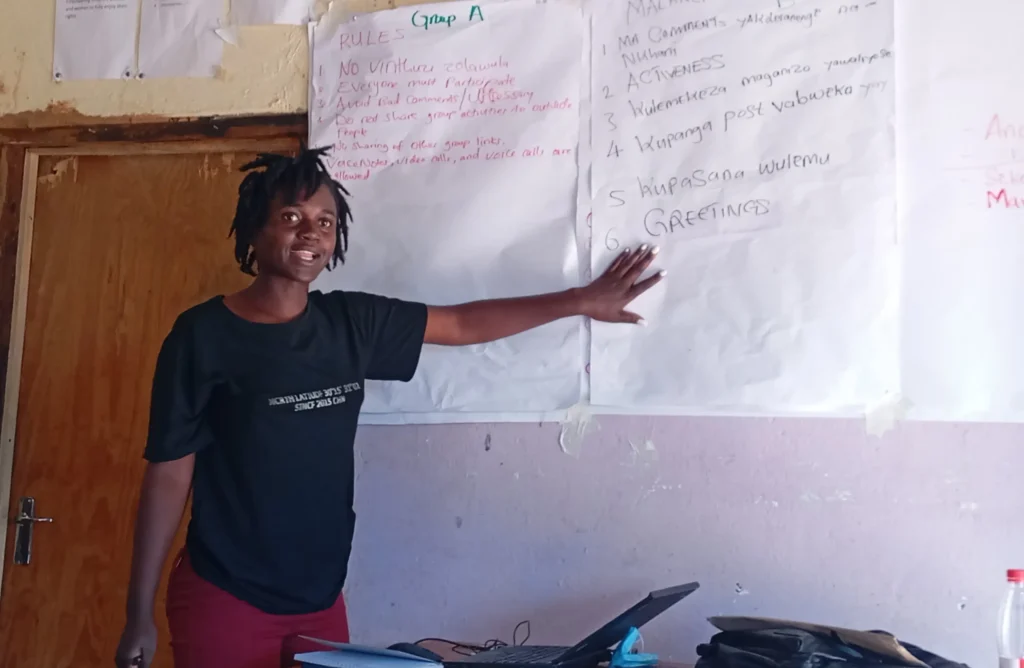
Two key training sessions formed the backbone of the project:
- A training on corruption monitoring and reporting mechanisms
- A training on digital security and whistleblower protection
In total:
- Over 20 youth leaders were trained, with a strong emphasis on inclusion and 60% female participation
- Two youth anti-corruption committees were established
- Participants received hands-on training in identifying, documenting, and reporting corruption
The digital security training was particularly critical. It addressed one of the biggest barriers to reporting corruption: fear. By learning how to protect their identity and data, participants gained the confidence to act.
At the same time, WhatsApp groups became active spaces for discussion, learning, and action.
From silence to action
“The WhatsApp groups have already been used actively by participants to report and discuss suspicious or questionable activities in their communities. In some cases, they ask for guidance on how to verify information and what evidence is needed before escalating matters.”

What makes this significant is not just the reporting—it is the shift in mindset.
“The groups have sparked new conversations that never happened before. Young people are now questioning local service delivery and sharing real-time concerns about possible corruption.”
Some are already identifying potential corruption cases and seeking proper reporting channels instead of remaining silent. This marks a significant shift from the culture of silence that existed before.
Lessons in co-creation and inclusion
A key takeaway from the project was realising the value of collaborating with communities rather than acting on their behalf.
“The most impactful moment was learning the importance of working with communities rather than for them. It shifted my thinking toward co-creation, seeing communities not as beneficiaries, but as partners.”

Inclusion was also central to the project’s success. Ensuring that 60% of participants were women was a deliberate choice to address gender imbalances in governance.
“This was important to ensure gender inclusion in governance spaces where women are often underrepresented.”
It also strengthened the initiative by bringing diverse perspectives, especially given that women and girls are disproportionately affected by corruption in service delivery systems.
Looking ahead: sustaining youth-led accountability
While the project has already made a strong impact, Rehema is focused on what comes next.
“The next step is to strengthen sustainability of the initiative beyond the project period. This includes addressing challenges like high data costs and limited device access, while building long-term systems for continuous youth engagement, peer learning, and stronger institutional linkages with accountability bodies.”
Through a simple platform like WhatsApp, young people are redefining what civic participation looks like in Malawi and proving that accountability does not always start in formal institutions, but often in everyday conversations.