Young people in Ghana understand elections. They learn about political parties and civic processes in school; they follow campaigns; and, as anyone who witnessed the celebrations following the country’s 2024 presidential election can attest, they feel democracy in their bones. But what happens after the ballots are counted?
For too many young Ghanaians, the answer is: not much. The skills, confidence, and tools needed to hold governments to account between elections remain out of reach for many young people. Meanwhile, political and social allegiances can sometimes complicate efforts to promote transparent and objective civic engagement.
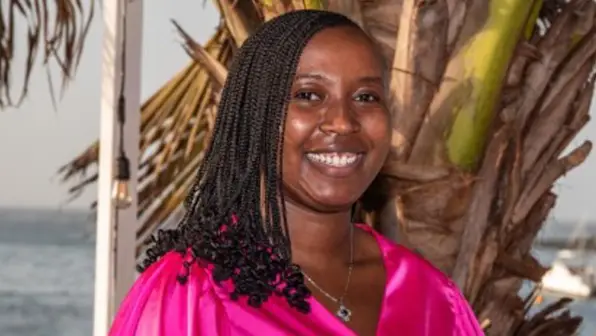
It is into this gap that Melissa Juisi Simo has stepped, armed with an unconventional tool: film.
A moment that could not be ignored
Melissa is a development economist and youth civil society practitioner who has spent her career working across West and Central Africa in programme design, institutional development, and policy. A Fulbright Scholar and alumna of the Center for Development Economics in the USA, she has trained civil society practitioners, consulted with universities, and contributed to research on gender, peace, and security. But an afternoon drive through Accra planted the seed for what would become The Lens.
“I was driving around Accra and I saw the joy, the celebration. Children were dancing and chanting in the streets. Their candidate had won. I sat with that image for a long time — because I had never seen anything like it in my own country. A president leaving power peacefully. A people electing their next leader with joy, with noise, with life.”
Yet even amid the euphoria, Melissa heard the scepticism. Will he do what he said he would do? Will things change? For someone who works in social accountability, that tension was all too familiar.
“I know that frustration is real, and I know it can hollow out democracy quietly, from the inside. So I asked myself: what can I do that meets people in that tension?”
Her answer was a film.
Accountability Hubs: A mentor for the journey
Melissa’s work on her project has been supported through the WYDE Civic Engagement Accountability Hubs programme.
For Melissa, two elements of the programme proved particularly transformative. The first was a visit to meet Tanzania’s former President. “That encounter changed something in me on multiple levels. It confirmed something I had been quietly wondering about: whether film, in this era, could genuinely move policy. After that visit, I stopped wondering.”
The second was the programme’s virtual learning sessions, which drew trainers and practitioners from diverse global contexts. For someone designing a project tailored to very specific local conditions in Ghana, that breadth of perspective was, she says, invaluable. “Rather than learning one model of civil society or one theory of change, we were constantly being invited to appreciate complexity.“
The programme’s core message stayed with her long after the sessions ended:
“Every generation has its most potent tools. Film is ours. Content is ours. Narrative is ours. That realisation gave me permission to pivot — and that pivot is what became The Lens.”
The Lens: Where policy meets storytelling
The Lens is Melissa’s project, and, in her words, it lives “at the intersection of policy, education, and entertainment with one singular intention: to inspire people, governments, and institutions towards better policies.” Its first major output is Something Good, a short film on social accountability set in James Town — one of Accra’s oldest and most vibrant communities, and, as Melissa puts it, “the least likely place for formal civic engagement, and yet one of the most powerful for mobilisation.“
The choice of James Town was deliberate. The raw energy and deep community bonds there are precisely what accountability movements need. By rooting the film in a recognisable, relatable setting rather than the rarefied world of policy seminars, Melissa wanted to reach the audience that conventional civic education rarely touches: the young person who is politically aware and deeply sceptical but has not yet found a way in.
“The most powerful ideas are not always the most complex ones — they are the ones that reach people where they are. Film does that. Storytelling does that.”
Taking the film to the streets — and the Secretariat
The first screening of Something Good was not in a cinema or a conference room. It was a street projection in James Town, where approximately 120 young people gathered under the open sky to watch it together.
“That moment was important not just as a metric, but as a proof of concept: that people would show up, that the film would hold a crowd, that the streets could become a civic space.”
Since then, the film has reached about 728 viewers through organic sharing within closed YouTube networks. These numbers are, as Melissa freely acknowledges, modest by design. “I am not yet in broadcast mode. I am in network mode, identifying the audiences who can carry this forward: youth organisations, civic educators, community mobilisers.“
Alongside the community screenings, Melissa has taken The Lens into the corridors of power. A presentation to the Ghana Education Service Secretariat was met with what she describes as genuine warmth — “real engagement and substantive feedback, all of which confirmed that the conversation was worth having at that level.” Her hope is straightforward:
“Young Ghanaians are already asking the right questions. The education system’s job is to channel it — and give it the language and tools it needs to become sustained civic action.”

Planting seeds for a more accountable future
The road ahead is long. Melissa is clear-eyed that producing a curriculum revision or a national policy shift will require sustained coalition-building, significant resources, and time. But the foundations are being laid. The film exists. The conversation with policymakers has begun. And the audiences who can carry the work forward are being identified and engaged.
What drives her is a conviction that investing in young people is not a gesture of goodwill — it is a strategic necessity.
“I see investment in young leadership not as charity or as preparation for some future moment. I see it as legacy. It is how institutions survive themselves.”
Her ask of every young person who watches Something Good is characteristically direct: “Ask one question you have never asked out loud before — about a policy, a budget, a decision that affects your life — and then commit to doing something with the answer. Not eventually. Now. Democracy does not run on elections alone. It runs on the daily decisions of people who refuse to be uninvolved.”